How to play Most Likely To — free online “who's most likely” game
Who's most likely to…? Point at a friend — agree with the room to score.
- Players
- 3–8
- Length
- ~6 min
- Type
- Roast
- Price
- Free
“Who's most likely to get us all thrown out?” Most Likely takes the classic group question and turns it into a scoring game: everyone points at one player in secret, and you score for every other person who pointed at the same target.
That rule quietly changes what you're playing. You aren't answering honestly — you're predicting the room's consensus. The person who wins is the one who best reads how everyone else sees the group, and the person who gets pointed at most takes the award, which is its own kind of winning.
A roast of the people in the room — pointing at friends lands best in person.
Free, no app and no sign-up to join — players hop in with a 4-letter code on their own phone.
How to play Most Likely
The host starts a room
Most Likely needs at least three players — with two there's no consensus to read and the game doesn't function. Seven rounds is the default, at about 25 seconds each.
Everyone joins with the room code
Players enter the 4-letter code on their own phone. Your pick stays on your screen until the reveal, so everybody needs their own device.
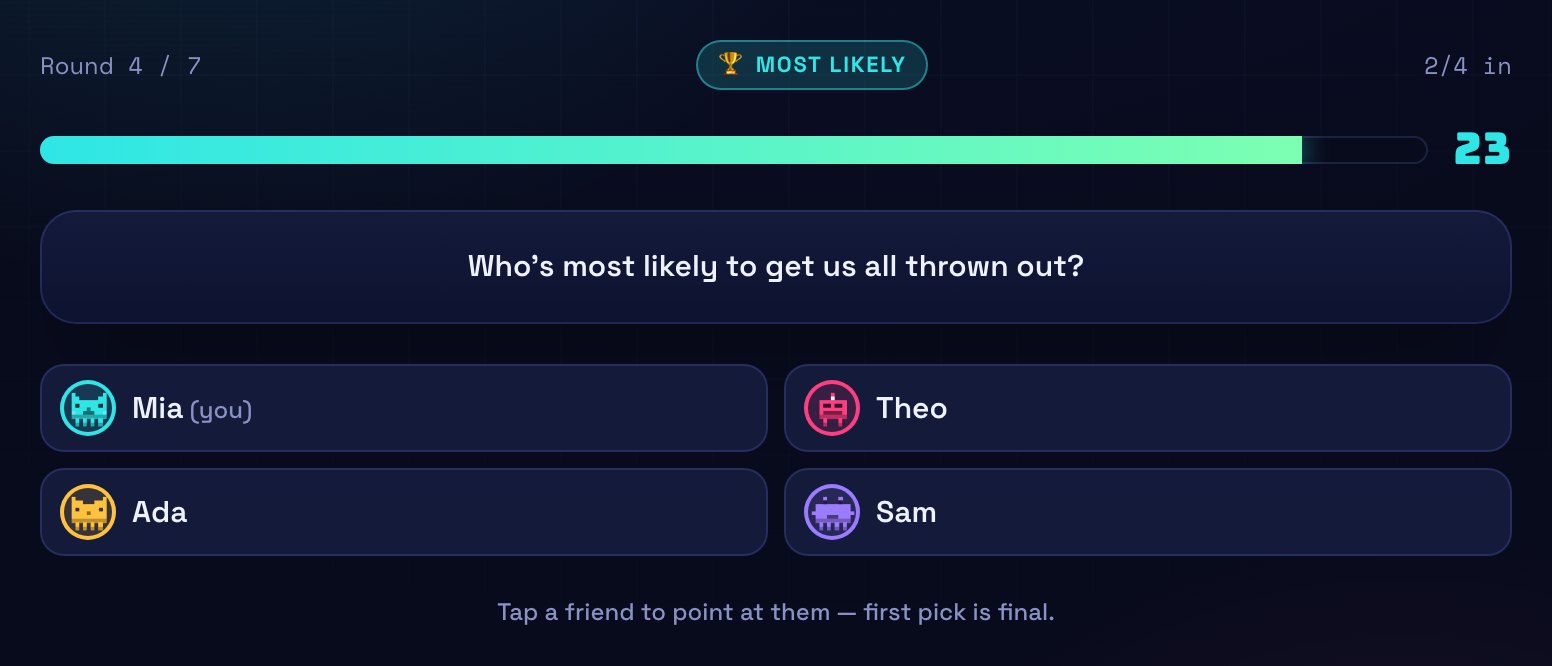
A “most likely to…” prompt drops
The same prompt appears on every screen at once, along with the list of everyone in the room.
Point at someone — including yourself
Tap the player you're accusing. You're allowed to point at yourself, and doing it at the right moment is one of the funnier plays available.
The reveal is the roast
Every pick goes up at once: who pointed at whom, who the room agreed on, and who quietly voted alone. The most-accused player takes the round's award.
What Most Likely looks like
How scoring works
You score 50 points for every other player who pointed at the same person you did. Agreement is the entire scoring mechanic — a lone correct-feeling vote is worth nothing at all.
That means the game rewards predicting consensus rather than telling the truth. If you privately think one person fits but you know the room will pick someone else, pointing at the room's answer is the higher-scoring play.
The most-voted player takes the round's award, and the biggest bloc of agreement is crowned on the reveal. Points accumulate across rounds and the highest total wins.
Tips for winning Most Likely
- Point at the obvious answer. Being clever and original is the fastest way to score zero — you need company, not accuracy.
- When there's no obvious answer, pick the loudest person in the group. Rooms default to whoever is most visible.
- Track who agreed with you in earlier rounds. Blocs form fast, and once you spot one you can ride it all game.
- Point at yourself when a prompt is unmistakably about you. Everyone else is pointing at you anyway, so you'll bank the full agreement bonus.
- This one lands hardest in person or on a call — the reveal is a roast, and roasts need reactions to be worth anything.
Frequently asked questions
How many players do you need for Most Likely?
Three at minimum, up to four. Three is the floor because the game scores agreement, and with two players there's no room consensus to read.
How is this different from a normal “most likely to” question?
You score for agreeing with the room rather than for being right. That turns it from a conversation into an actual game with a winner, and it means the smart play is often not your honest answer.
Can I vote for myself?
Yes, and sometimes you should. If everyone else is obviously pointing at you, pointing at yourself banks the agreement points.
Is it free to play?
Yes — free to play and free to host, with no account required to join a room.
How long does a game take?
About 6 minutes, which makes it one of the quickest games in the catalogue and a good opener or closer for a longer session.
Free, no app and no sign-up to join — players hop in with a 4-letter code on their own phone.