How to play Imposter — free online social deduction game
One faker, one secret word. Bluff a clue — or sniff out who doesn't belong.
- Players
- 3–8
- Length
- ~8 min
- Type
- Deduce
- Price
- Free
Imposter is a fast social deduction game with one hidden faker. Everyone in the room is shown the same secret word — everyone except one player, who is shown nothing and has to fake it. Each player submits a single one-word clue, and then the room votes on who doesn't belong.
The tension comes from the clue being one word. Too vague and the room reads you as the imposter; too specific and you've handed the imposter the word for free. And if you are the imposter, you're writing a clue for a word you're trying to reverse-engineer from everybody else's clues in real time.
One faker holds a secret word: you want a call to sniff them out, and your own clue screen kept hidden.
Free, no app and no sign-up to join — players hop in with a 4-letter code on their own phone.
How to play Imposter
The host picks a mode and round count
Classic gives everyone but the imposter the word. Undercover and Blind change who knows what — including a variant where you don't know your own role — which turns confident play into a liability. Eight rounds is the default.
Roles and the word are dealt in secret
Every player's screen tells them privately what they need to know. Keep it to yourself: this is one of the games where a glance at a neighbour's phone spoils the round completely.
Everyone submits one clue word
One word, related to the secret word, that proves you know it without saying it outright. Everyone writes at the same time, so nobody can simply copy the clue before them.
Talk it out, then vote
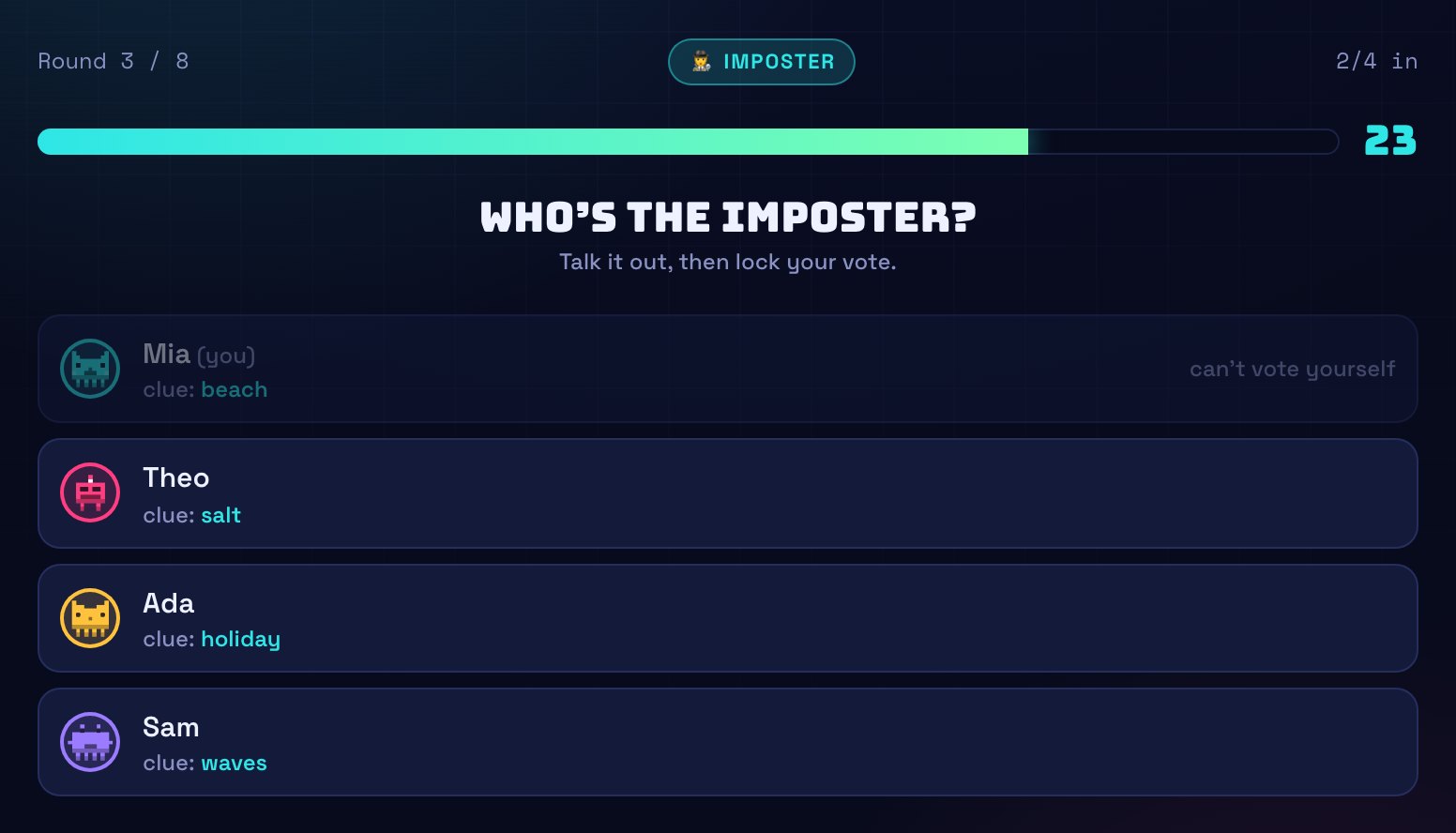
All the clues go up together and the room votes on who the imposter is. This is where a call or a group chat earns its keep — the clues alone rarely settle it, and the argument about why someone's clue was suspicious is the actual game.
A caught imposter gets one last shot
If the room votes correctly, the imposter isn't dead yet: they get a steal window to name the secret word outright. Guess it and they take the round anyway, which means the room's job isn't finished at the vote.
What Imposter looks like
How scoring works
Players score for correctly identifying the imposter, so a round the room reads well pays everybody who voted right.
The imposter scores for surviving the vote — and, if caught, can still steal the round by naming the secret word during the steal window. That second chance is why giving an over-specific clue is dangerous even when you're winning.
Scores accumulate across rounds and the role changes round to round, so a game is decided by how well you play both jobs rather than by which one you drew.
Tips for winning Imposter
- As a normal player, aim one step sideways from the word — related enough to prove you know it, oblique enough that an imposter can't ride it home.
- Never give a clue that only makes sense if you already know the word exactly. That's the one that gets stolen at the end.
- As the imposter, go last in spirit: write something broad enough to fit whatever the earlier clues implied, and lean on the vaguest theme you can spot.
- Watch for the player whose clue fits every clue before it. Genuine players tend to pick their angle before they see the room's; imposters converge.
- An early confident accusation is itself information. Imposters accuse to look busy more often than they stay quiet.
Frequently asked questions
How many players do you need for Imposter?
At least three, up to six. It's one of the few games here that seats six, because social deduction needs a crowd — with three the vote is too small to hide in.
Is Imposter like Among Us or Spyfall?
It's closest to Spyfall and the word-based deduction family: one player lacks the secret information and has to blend in. It runs in the browser with no install, and rounds take a minute or two rather than a whole session.
Do we need voice chat to play Imposter?
It's much better with one, because arguing about the clues is the heart of the game — but it is not required. A group text chat does the job, and no player is ever blocked from participating without a mic.
What are the different modes?
Classic is the standard one-faker setup. Undercover and Blind vary who knows their own role, including a variant where nobody is certain they aren't the imposter.
Is it free?
Yes — free to play, free to host, and joining needs only the room code.
Free, no app and no sign-up to join — players hop in with a 4-letter code on their own phone.