How to play Garland — free online co-op clue puzzle game
Weave four clues around your ring, then rebuild a friend's from theirs.
- Players
- 3–6
- Length
- ~9 min
- Type
- Weave
- Price
- Free
Garland deals you a private ring of four words and asks you to write one clue bridging each neighbouring pair. Then the words are stripped away, your clues are shuffled, a decoy is added, and the whole lot is handed to a friend.
Their job is to rebuild your ring using nothing but your clues. It's co-operative — every slot they get right feeds the room's shared pot — so the game is really about whether you can write clues that mean the same thing to someone else's brain as they do to yours.
One team, one score: the whole room wins together, and the finale celebrates what you pulled off as a group — no podium, no loser.
Your ring and its clues are yours alone — don't let the solver see your board.
Free, no app and no sign-up to join — players hop in with a 4-letter code on their own phone.
How to play Garland
The host picks the round count
Three rounds is the default. Two is a quick game; four is a full session.
You're dealt a private ring
Four words arranged in a ring, on your screen alone. Each neighbouring pair needs one clue.
Write a bridging clue for each pair
One word that connects both words in the pair — that's four clues in total, and each has to work in two directions at once.
Your clues go to a friend
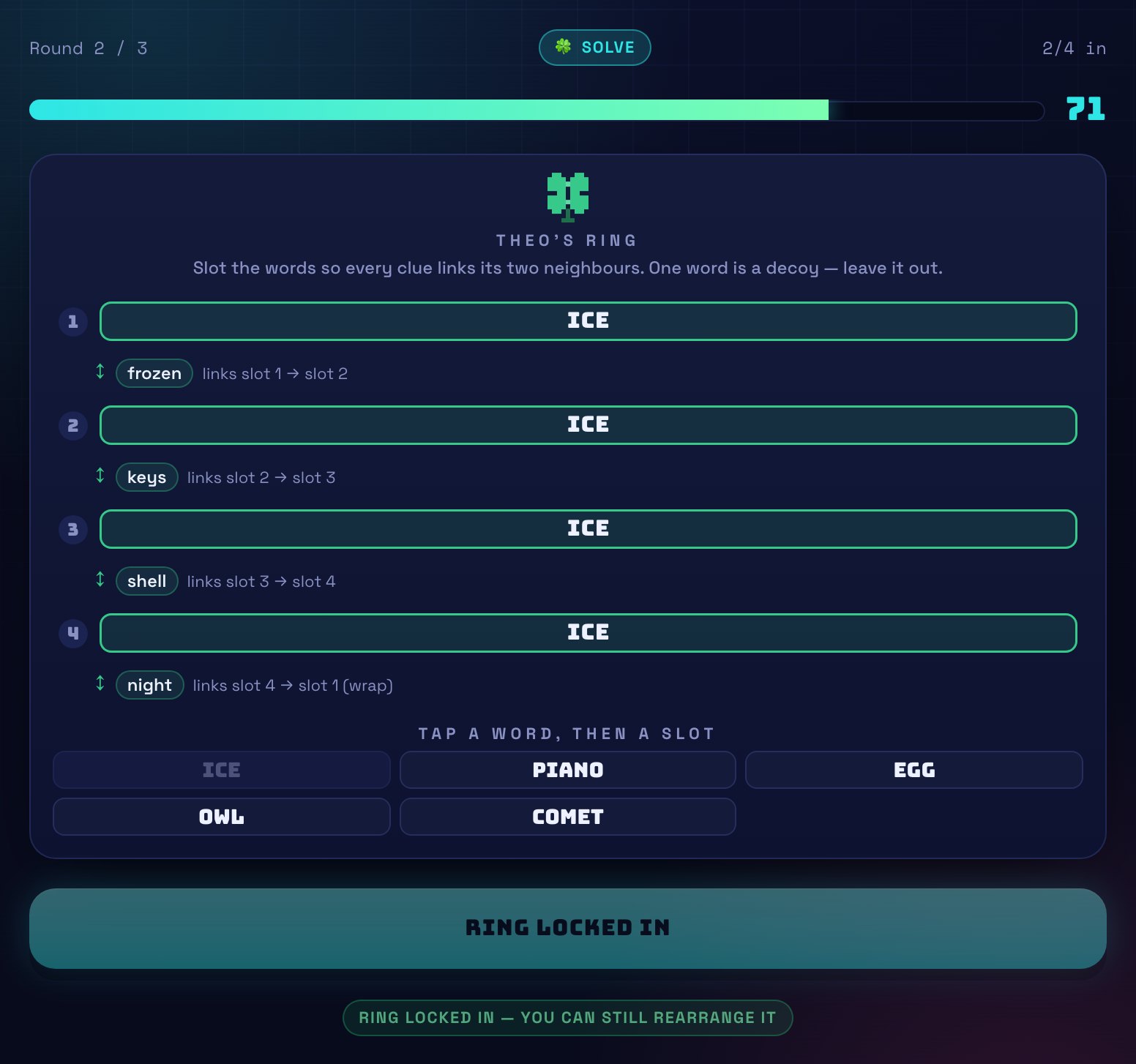
The words are stripped out, the clues are shuffled, and a decoy word is added to the pile. A friend receives that and rebuilds the ring.
Every right slot feeds the pot
The reveal shows what they reconstructed against your original ring, and the room's shared score goes up for each correct placement.
What Garland looks like
How scoring works
Garland is co-operative: the whole room banks into one shared pot rather than competing, and the finale is a team verdict rather than a podium.
Every slot a solver places correctly adds to that pot, so a clue that reads clearly is worth exactly as much whoever wrote it.
The decoy word is what stops the puzzle from solving itself by elimination — it means the last slot is never free.
Tips for winning Garland
- Pick the clue that only works for that pair. A word that plausibly connects three of your four words is what sends solvers into the wrong slot.
- Avoid clues that lean on your own associations. The solver doesn't share your holiday memories — they only have the word.
- Concrete over abstract, every time. 'Water' places; 'freedom' does not.
- As solver, place your most confident pair first and work around the ring from there. The ring structure means one certainty constrains its neighbours.
Frequently asked questions
How many players do you need for Garland?
Three to four. You need enough people that everyone's ring goes to someone else.
Is Garland like So Clover?
It's the same lineage — bridging clues around a ring, reconstructed by another player, scored co-operatively. Garland uses its own word bank and runs free in the browser.
Is it competitive?
No. It's co-operative: the room shares one score and wins or falls short together.
Is it free?
Yes, free to play and free to host, with no account needed to join.
Free, no app and no sign-up to join — players hop in with a 4-letter code on their own phone.