How to play Polyglot, the free online guess-the-language game
One sentence, four languages. Which one is it?
- Players
- 1–8 (solo too)
- Length
- ~5 min
- Type
- Languages
- Price
- Free
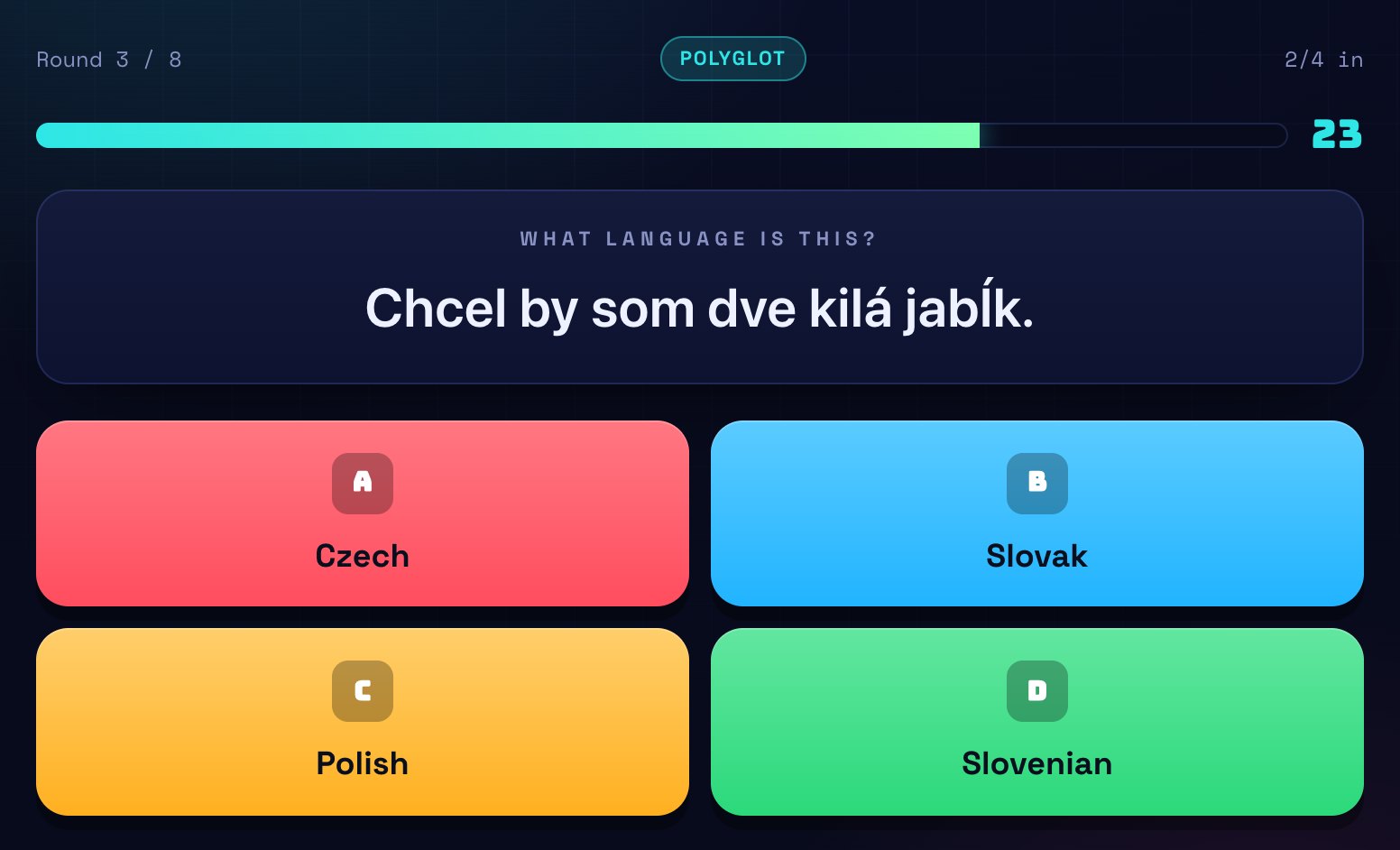
Polyglot shows everyone the same short sentence, written the way its speakers write it. It might be Polish, Tamil, Yiddish or Georgian. You pick which of four languages it is, and quick right answers score the most.
You don't need to speak any of them. Most rounds come down to spotting clues: a letter with an unusual mark, a word you half recognise, the shape of the alphabet. The reveal tells you what the sentence means and one fact about the language, so you get a little better each round.
Free, no app and no sign-up to join — players hop in with a 4-letter code on their own phone.
How to play Polyglot
The host picks how many sentences
Ten is the default. The host can also set the difficulty and turn off speed points in the game setup.
A sentence appears
Everyday stuff, like asking the way to the station or saying you like tea. Names of people and places are left out, because they give the answer away.
Pick one of four languages
Usually one of the wrong answers is a close cousin of the right one, like Czech next to Slovak, or Persian next to Arabic.
Answer before the timer runs out
Once everyone has picked, the round ends early.
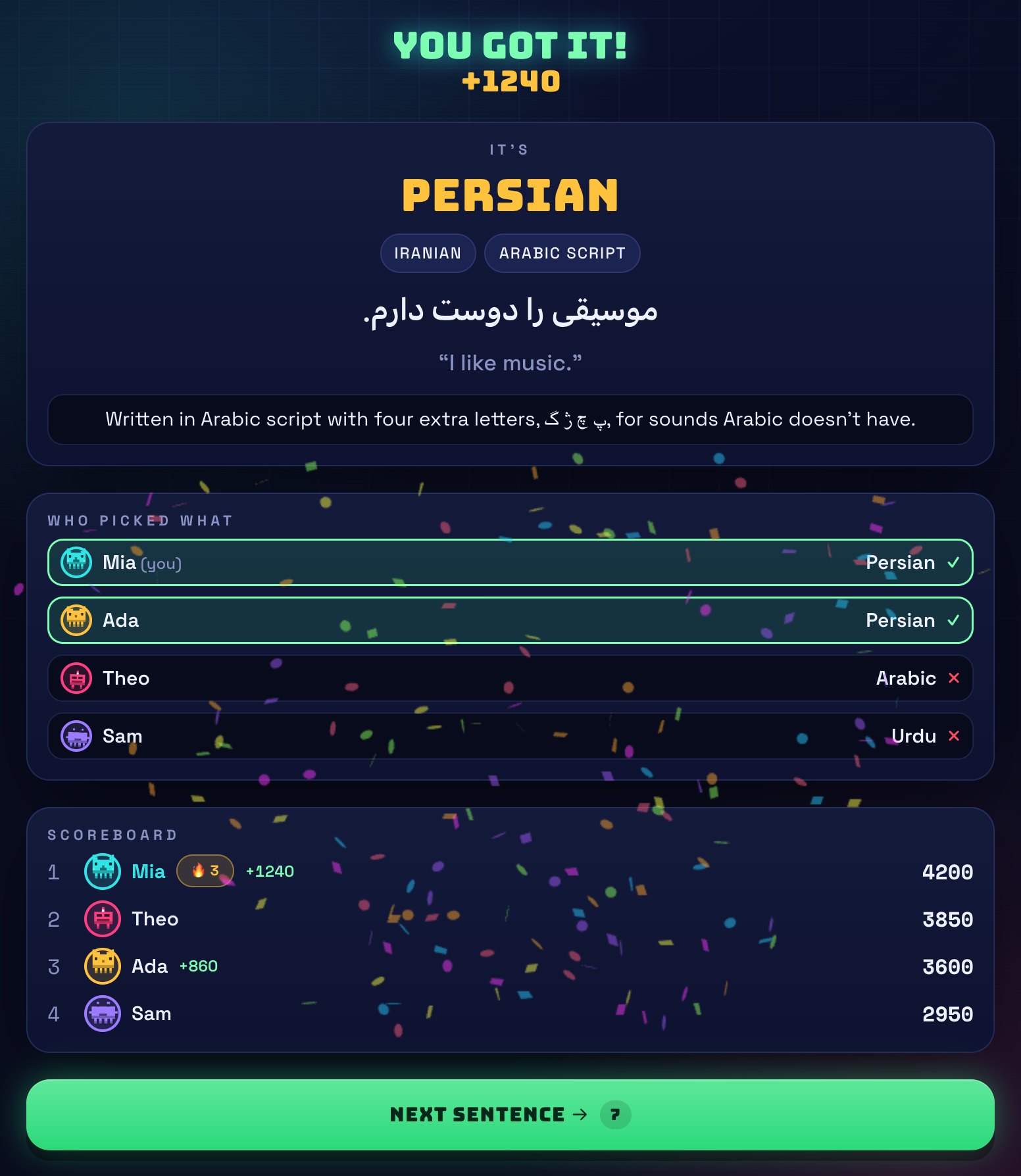
See the answer
The reveal names the language, gives the English translation, shows who picked what, and adds one fact about the language.
What Polyglot looks like
How scoring works
A right answer scores more the faster you give it. A wrong answer or no answer scores nothing.
Right answers in a row build a streak, and a streak multiplies your points for each right answer that follows.
With the no speed points rule on, every right answer is worth the same, so you can take your time.
Points add up over the game and the highest total wins.
Tips for winning Polyglot
- Look at the letters before the words. ł means Polish, ř means Czech, ő and ű mean Hungarian, and ə means Azerbaijani.
- In Cyrillic, і and ї point to Ukrainian, ў to Belarusian, and ќ or ѓ to Macedonian.
- Arabic script is shared by Arabic, Persian and Urdu. Letters like پ and گ rule out Arabic.
- Hebrew letters with lots of small vowel marks and words like איז or נישט are probably Yiddish, not Hebrew.
- In the scripts of India, a line along the top joining the letters means Hindi, Marathi or Nepali. Gujarati looks similar without the line.
- Japanese mixes simple rounded symbols in among the Chinese characters. Korean letters sit in little square blocks with circles and lines.
Frequently asked questions
How many players do you need?
One to eight. Everyone scores on their own, so it works solo too, and you can fill seats with Blips (computer players that guess right about half the time).
How many languages are there?
73, each with several sentences: most of Europe's languages, plus Arabic, Persian, Hebrew, Hindi, Bengali, Tamil, Thai, Khmer, Mandarin, Cantonese, Japanese, Korean, Amharic and more. You won't see the same sentence again until you've seen the rest.
What do the difficulty levels change?
Easy uses better-known languages and keeps close cousins out of the wrong answers. Hard uses the rarer languages and puts each one next to the languages it looks most like. Mixed, the default, is in between.
Where do the sentences come from?
From Tatoeba (tatoeba.org), a free, volunteer-built collection of sentences and translations, shared under the CC BY 2.0 FR licence. Thanks to the Tatoeba contributors. We picked each sentence by hand and reworded a few translations.
How long is a game?
About 5 minutes at the default ten sentences.
Is it free?
Yes. It's free to play and free to host, and joining only needs the room code.
Free, no app and no sign-up to join — players hop in with a 4-letter code on their own phone.