How to play Mirage — free online cryptic clue picture game
See a secret vision, drop a cryptic clue — too obvious or too obscure and you score nothing.
- Players
- 3–8
- Length
- ~8 min
- Type
- Clues
- Price
- Free
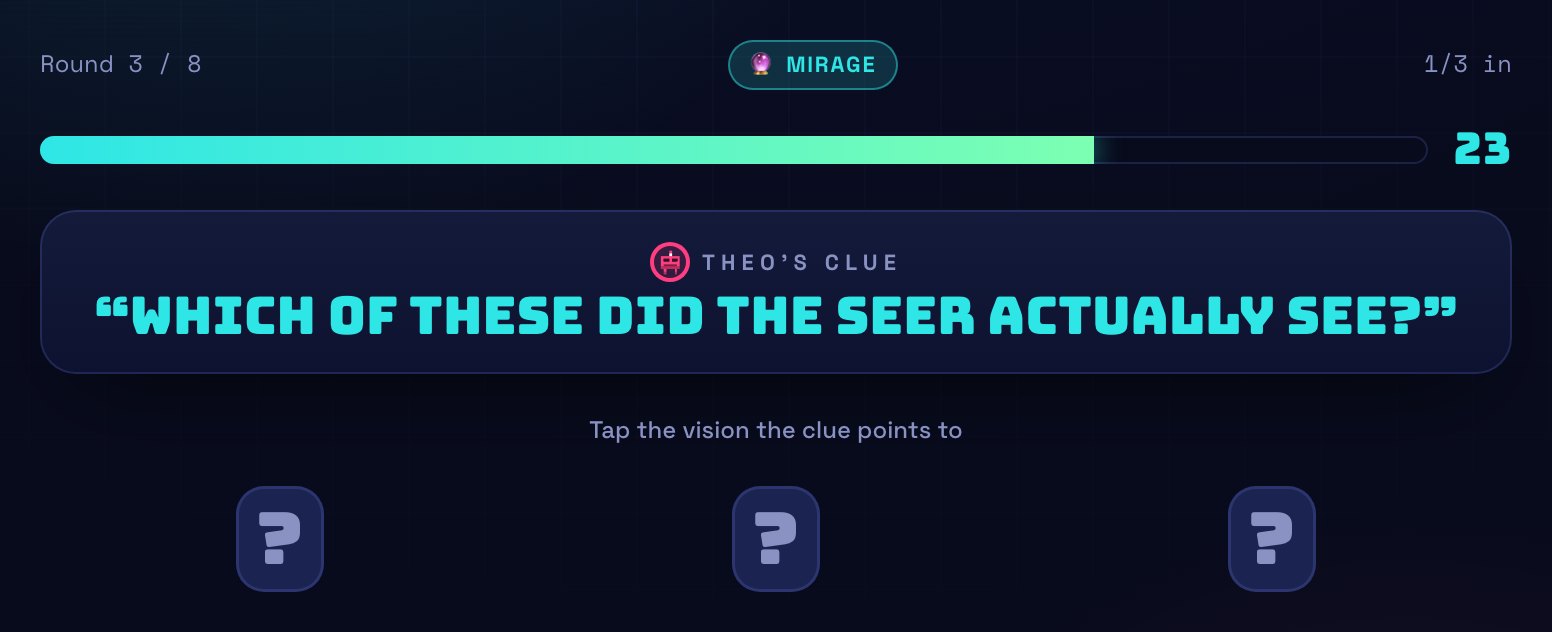
Mirage gives one player a secret picture and one line to describe it. Everyone else then sees a board of pictures and votes on which one the clue meant.
The scoring is the clever part: the seer only scores if SOME of the room finds it. Everyone getting it means the clue was too obvious; nobody getting it means it was too obscure. You're aiming for exactly the middle, every single round.
The seer's vision is on their screen alone.
Free, no app and no sign-up to join — players hop in with a 4-letter code on their own phone.
How to play Mirage
The host picks the round count
Six rounds is the default; nine or twelve for a longer game.
One player becomes the seer
The role rotates. They see a secret vision on their screen alone — nobody else gets a glimpse.
The seer writes one oblique clue
One line, deliberately slanted. Too literal and everyone gets it; too poetic and nobody does.
The board of visions is revealed
Everyone else sees a spread of pictures, one of which is the seer's.
Vote on which one it meant
The reveal shows the true vision and who found it — and whether the seer threaded the needle.
What Mirage looks like
How scoring works
The seer scores only when some but not all of the room picks correctly. A unanimous room and an empty one both pay the seer nothing.
Guessers score for finding the right vision, so their incentive is straightforwardly to be right.
That asymmetry is the whole design: it forces the seer into genuinely interesting clue-writing rather than either extreme. The role rotates, so everyone faces the same problem.
Tips for winning Mirage
- As seer, aim at one specific person. A clue that your closest friend will get and the rest won't is exactly the target.
- Use associations rather than descriptions. Describing what's in the picture is the fast route to a unanimous room and zero points.
- As a guesser, ask what the seer would think is clever — the clue is a personality test as much as a description.
- Don't repeat a clue style across rounds. Once the room knows how you think, your clues get too easy.
Frequently asked questions
How many players do you need for Mirage?
Three to four.
Is Mirage like Dixit?
Yes — it's that family: a cryptic clue for a hidden picture, scored so that being too obvious is as bad as being too obscure. Mirage uses pixel art visions and runs free in the browser.
Why doesn't the seer score when everyone gets it?
Because the clue was too easy. The scoring exists to push seers toward clues that split the room, which is where the interesting play is.
Is it free?
Yes, free to play and free to host, with no account needed to join.
Free, no app and no sign-up to join — players hop in with a 4-letter code on their own phone.